
- Brass Chemical Cleaning Now Available at Salisbury Music
- King Musical Instrument Historical Site
- Custom Sax Palm Key Risers
- Contrabass Sax Quartet Video
- Repair Tool of the Week – Screwdrivers
Brass Chemical Cleaning Now Available at Salisbury Music
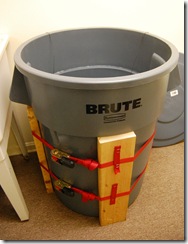 Several months ago I attended a band instrument repair clinic in Norfolk, VA, where one of the clinicians talked about the "proper" way of cleaning the inside of brass instruments. Over the years there have been many theories and processes of chemical cleaning, but each had their issues. Due to those issues Salisbury Music has never been an advocate of "chemical cleaning". The clinician, Ken Skitch, had a trombone customer that also happened to own a chemical company. One day, while the customer was in the store he asked Ken how he "cleaned" the inside of brass instruments. After Ken explained the process he used, the customer told him he was doing it all wrong, and would get back to him. Long story short, Ken and the customer developed a brass cleaner that effectively cleans the crud and gunk out of the inside of a brass instrument, without etching or degrading the structural material of the instrument, whether it’s brass, nickel or silver. This solution is safe with lacquer and plated instruments.
One of the more common problems with brass instruments I have been seeing recently is the corrosion and degradation of the brass from the "junk" that’s not getting effectively cleaned out. This is even more evident on newer instruments that have less metal mass than older sturdier instruments. Compare a 30-year-old Olds Ambassador Baritone to a new Jupiter Baritone and you’ll see exactly what I’m talking about.
Salisbury Music is now proud to offer this "chemical-cleaning" service to the customers on the Eastern Shore. While our system is hardly high tech, we are now able to chemically clean the inside of the following instruments:
- trumpets
- trombones
- mellophones
- marching brass
- french horns
- baritones/euphoniums
- saxophone bodies
Basically anything other than tubas at this stage, although we may be able to fit small 3/4 tubas in our tank, but we’ll have to see.
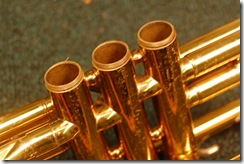
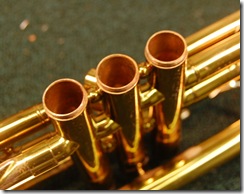
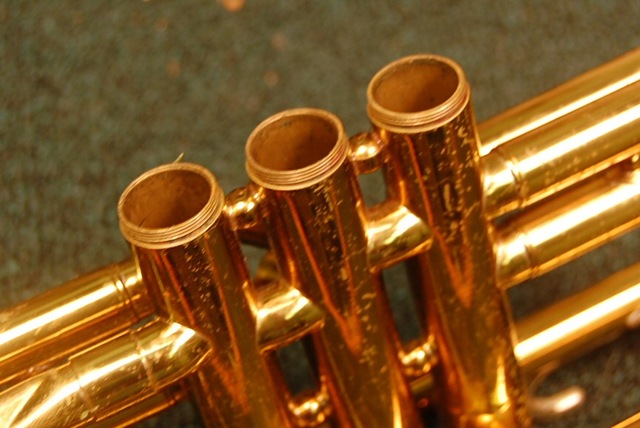
Below are some before and after pictures of a trumpet we chemically cleaned. If you have any questions or would like more information, feel free to contact me.
BEFORE AFTER



King Musical Instrument Historical Site
This is a very cool website I stumbled across on the history of King Musical Instruments.
Check it out HERE
Custom Sax Palm Key Risers

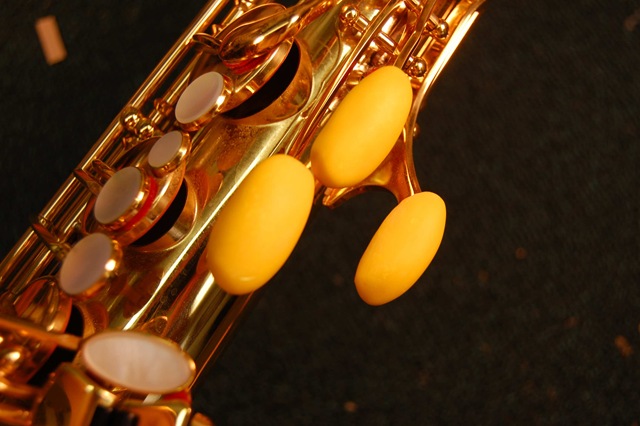
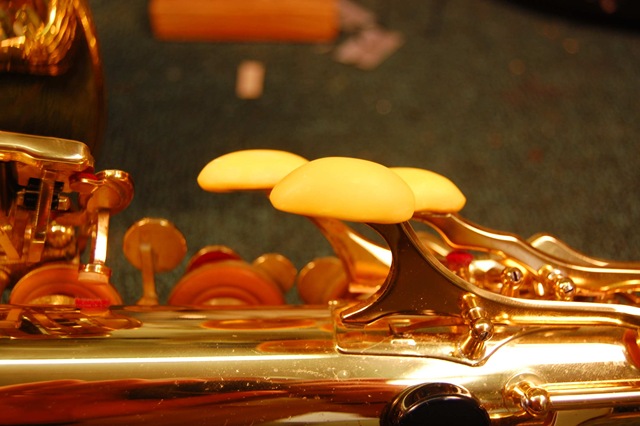
A typical problem with saxophones is the height (or lack of) of the palm keys, that are played with the left hand. Depending on the size of the players hand, theses keys are sometimes quite below the palm of the hand. Adding Palm Key Risers is a fairly simple customization, allowing a player with larger hands to have a better “feel” for the instrument. In the pictures are the Custom Palm Key Risers I made for my personal sax (Yamaha YTS-875 Custom Series Tenor). These risers are made from a polymer material, baked to 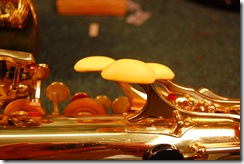 harden them, and then lightly glued on. They are completely removable, should the player ever wish to sell the instrument or need to remove them for some reason. They are available in a variety of colors, mine just happen to be yellow.
Contrabass Sax Quartet Video
Piece for 4 Contrabass Saxophones (More specifically, 2 Eb Contrabass Saxophones, 1 Eb Tubax and one Bb Subcontrabass Tubax)
Written by Adam Gilberti, performed at UCLA by Jay C. Easton, Grant Green, Blaise Garza, and Adam Gilberti.
Repair Tool of the Week – Screwdrivers
 Pictured are just some of the screwdrivers I use in the repairing of band instruments. The 3 Red-Topped on the left are Wiha Phillips head screwdrivers. The other 11 multi-color top screwdrivers are Kraus slotted screwdrivers. These are screwdrivers made specifically for the band instrument repair trade. The colored tops are interchangeable, and I use the colors to denote what size blade each screwdriver is. That way if I’m using a green-topped screwdriver and need a longer or shorter length, it’s very easy to grab the correct one. Using the correct blade width is critical so that I don’t damage the slot in the screw/rod, or have the screwdriver slip out of the slot.
- RED – Blade width=.060” x 1.5” length
(used on flute/oboe adjustment screws)
- GREEN – Blade width = .070” x 1.5”, 3”, & 6” lengths
(rods on smaller woodwinds)
- PURPLE – Blade width = .085” x 3” & 6” lengths
(headless pivot screws on smaller woodwinds, smaller rods on saxes)
- BLACK – Blade width = .100” x 3” & 6” lengths
(headed pivot screws on smaller woodwinds, stack rods on saxes)
- GOLD – Blade width = .125 x 1.5” & 6”lengths
(headed pivot screws on saxes and other large woodwinds)
- BLUE – Blade width = .156 x 4” length
(large pivot screws and flute pad screws)
Want to own a set?
Each screwdriver body, colored top, & blade costs me approximately $39.

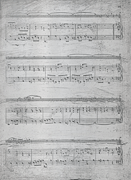 G. Henle Vertag no longer hand-engraves their printing plates as computer notation programs have advanced. However you can own a piece of history. G. Henle is selling their vast inventory of Lead Engraving Plates. Retailing for $91.00 each plate is unique, however, you CANNOT order a specific title. You get whatever they send.
 15% Music Teacher Discount on Most Music
 I’ve Never Seen














 Joel Smith Music