Bench Notes – June 1, 2009

bench notes_bd

  • Banana Flute
  • Summer Hours
  • Some People Just Have Too Much Time on Their Hands
  • Buffet Crampon New York Showroom Opening


Banana Flute

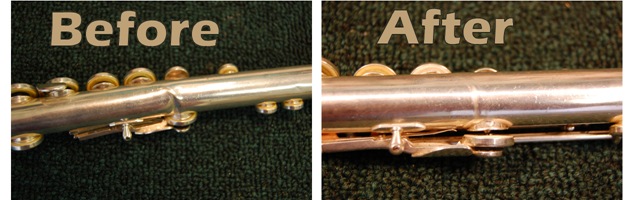
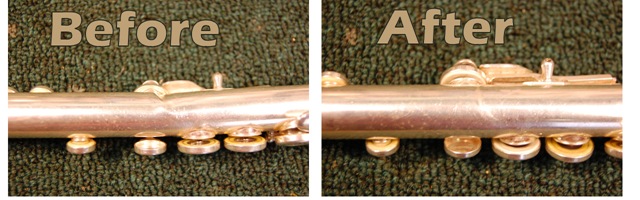
This is what is commonly referred to as a Banana Flute in the repair industry. Basically a flute that has been sat on and bent, making it look like a banana.  Below are some before and after pictures from a recent flute brought in for repair. This particular Gemeinhardt was bent between the Thumb Bb key and the B Key.

banana flute 1

banana flute 2

Several factors come into play on this type of repair.

  1. The body tube needs to be straightened and the “dents” removed. (this is done with the keys in place)
  2. Any tone holes affected need to be reshaped and leveled. (in this case the Bb & B tone holes needed major work)
  3. Finally, any key adjustment and regulation has to be done, so nothing binds or has too much lost motion.

You can still see where the “dents” were, when the metal stretches the silver-plate micro-fractures, leaving the “cloudy” appearance.  The plating can be stripped and the instrument re-plated, but most customers don’t opt for that.


image Summer Hours

Effective June 1, 2009, Salisbury Music will be closed on Saturday’s. We will re-institute Saturday hours sometime in August, but we look forward to taking some much needed time off. For the summer our hours will be:

  • Mon-Fri 10am – 5pm


Some People Just Have Too Much Time on Their Hands


image Buffet Crampon
New York Showroom Opening

Showcasing Buffet Crampon woodwinds, Besson brass, and Antoine Courtois brass, the new Buffet Crampon New York Showroom will be celebrating its grand opening on Friday, June 5th from 2pm – 6pm at 160 W 48th Street, 4th Floor, NYC, 10036.

Bench Notes – May 26, 2009 Tuesday Edition

bench notes_bd

  • Original G. Henle Music Engraving Plates Available for Purchase
  • 15% Music Teacher Discount on Most Music
  • Over-Stock Blowout
  • I’ve Never Seen This Before


Original G. Henle Music Engraving Plates Available for Purchase

G. Henle Engraving Plate G. Henle Vertag no longer hand-engraves their printing plates as computer notation programs have advanced. However you can own a piece of history. G. Henle is selling their vast inventory of Lead Engraving Plates. Retailing for $91.00 each plate is unique, however, you CANNOT order a specific title. You get whatever they send.


15 percent1 15% Music Teacher Discount on Most Music

Did you know that Music Teachers get a 15% discount on most music that we have in stock or order for you? 

  • Band Arrangements
  • Choral Arrangements
  • Method Books
  • Supplementary Materials

Plus we never charge shipping on orders we deliver by van to the school.

Stretch those budget dollars!!!


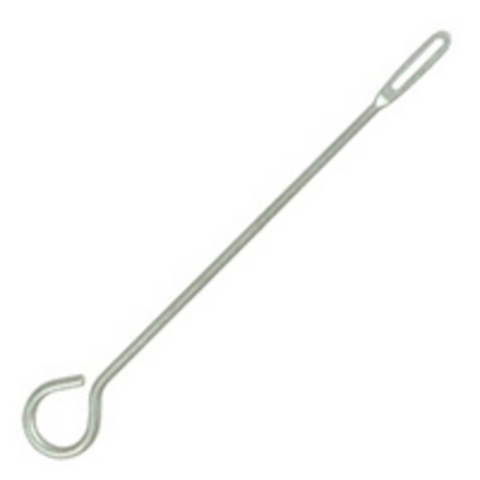
valve cleaning rod

Over-Stock Blowout

Trumpet Valve Cleaning Rod

Retail Price = $5.50

Normal BD Price = $4.40

OVER-STOCK PRICE = $2.99

While Supplies Last


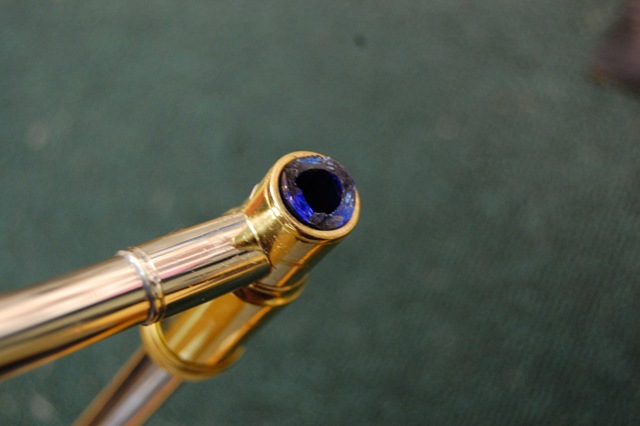
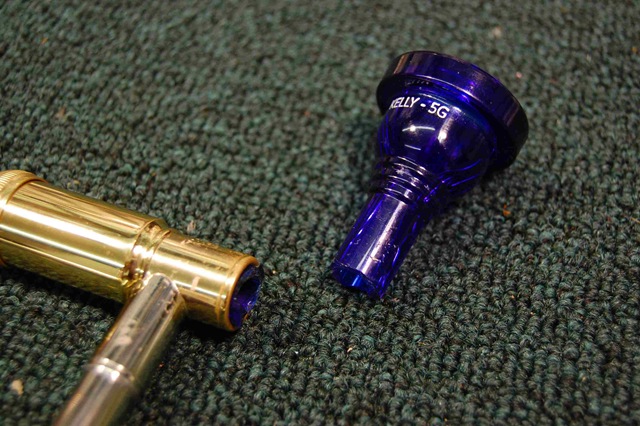
Broken Kelly MP Shank Stuck in Trb I’ve Never Seen
This Before

Trombone comes in with a plastic Kelly Mouthpiece broken off in the mouthpiece receiver. Customer should be glad it was a trombone with a straight shot up the slide…a trumpet, baritone, tuba with limited or no access from the other end would have been MUCH harder to remove, which also meant it would have cost A LOT more t0 fix.  Even with straight access on this trombone, I had to be EXTREMELY careful not to damage the tapered leadpipe in the receiver side of the outside slide. 

Before Removal After Removal

Bench Notes – May 18, 2009

bench notes_bd

  • Brass Chemical Cleaning Now Available at Salisbury Music
  • King Musical Instrument Historical Site
  • Custom Sax Palm Key Risers
  • Contrabass Sax Quartet Video
  • Repair Tool of the Week  –  Screwdrivers


Brass Chemical Cleaning Now Available at Salisbury Music

Our High-Tech Chemical Tank Several months ago I attended a band instrument repair clinic in Norfolk, VA, where one of the clinicians talked about the "proper" way of cleaning the inside of brass instruments. Over the years there have been many theories and processes of chemical cleaning, but each had their issues. Due to those issues Salisbury Music has never been an advocate of "chemical cleaning". The clinician, Ken Skitch, had a trombone customer that also happened to own a chemical company. One day, while the customer was in the store he asked Ken how he "cleaned" the inside of brass instruments. After Ken explained the process he used, the customer told him he was doing it all wrong, and would get back to him. Long story short, Ken and the customer developed a brass cleaner that effectively cleans the crud and gunk out of the inside of a brass instrument, without etching or degrading the structural material of the instrument, whether it’s brass, nickel or silver. This solution is safe with lacquer and plated instruments.

One of the more common problems with brass instruments I have been seeing recently is the corrosion and degradation of the brass from the "junk" that’s not getting effectively cleaned out. This is even more evident on newer instruments that have less metal mass than older sturdier instruments. Compare a 30-year-old Olds Ambassador Baritone to a new Jupiter Baritone and you’ll see exactly what I’m talking about.

Salisbury Music is now proud to offer this "chemical-cleaning" service to the customers on the Eastern Shore. While our system is hardly high tech, we are now able to chemically clean the inside of the following instruments:

  • trumpets
  • trombones
  • mellophones
  • marching brass
  • french horns
  • baritones/euphoniums
  • saxophone bodies

Basically anything other than tubas at this stage, although we may be able to fit small 3/4 tubas in our tank, but we’ll have to see.

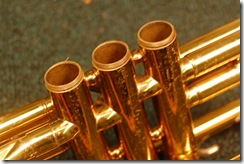
Below are some before and after pictures of a trumpet we chemically cleaned. If you have any questions or would like more information, feel free to contact me.

BEFORE                                                    AFTER
bundy_before1 bundy_after1

bundy_before2 bundy_after2


KING MUSICAL INSTRUMENTS

King Musical Instrument Historical Site

This is a very cool website I stumbled across on the history of King Musical Instruments.

Check it out HERE


Custom Sax Palm Key Risers

Custom Palm Key Risers

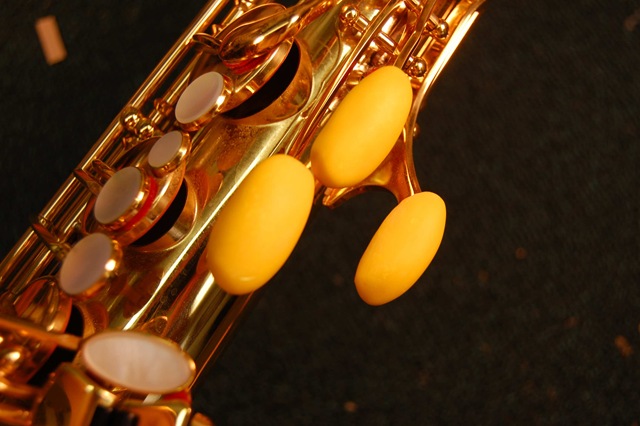
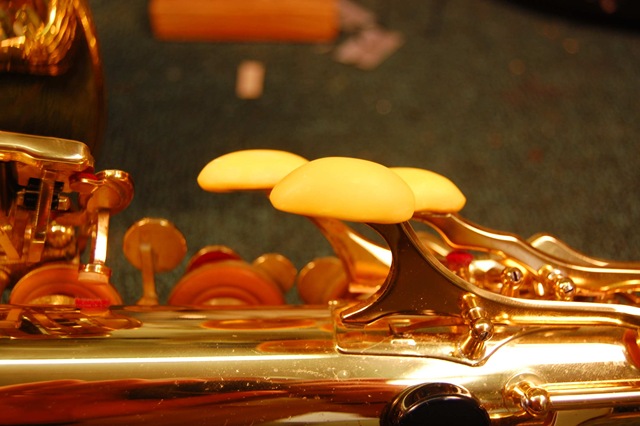
A typical problem with saxophones is the height (or lack of) of the palm keys, that are played with the left hand. Depending on the size of the players hand, theses keys are sometimes quite below the palm of the hand. Adding Palm Key Risers is a fairly simple customization, allowing a player with larger hands to have a better “feel” for the instrument. In the pictures are the Custom Palm Key Risers I made for my personal sax (Yamaha YTS-875 Custom Series Tenor). These risers are made from a polymer material, baked to Custom Palm Key Risersharden them, and then lightly glued on. They are completely removable, should the player ever wish to sell the instrument or need to remove them for some reason. They are available in a variety of colors, mine just happen to be yellow.
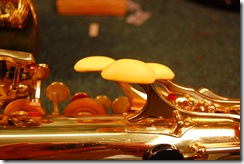
Contrabass Sax Quartet Video

Piece for 4 Contrabass Saxophones (More specifically, 2 Eb Contrabass Saxophones, 1 Eb Tubax and one Bb Subcontrabass Tubax)
Written by Adam Gilberti, performed at UCLA by Jay C. Easton, Grant Green, Blaise Garza, and Adam Gilberti.


Repair Tool of the Week –   Screwdrivers

screwdriversPictured are just some of the screwdrivers I use in the repairing of band instruments. The 3 Red-Topped on the left are Wiha Phillips head screwdrivers. The other 11 multi-color top screwdrivers are Kraus slotted screwdrivers. These are screwdrivers made specifically for the band instrument repair trade. The colored tops are interchangeable, and I use the colors to denote what size blade each screwdriver is. That way if I’m using a green-topped screwdriver and need a longer or shorter length, it’s very easy to grab the correct one. Using the correct blade width is critical so that I don’t damage the slot in the screw/rod, or have the screwdriver slip out of the slot.

  • RED – Blade width=.060” x 1.5” length
    (used on flute/oboe adjustment screws)
  • GREEN – Blade width = .070” x 1.5”, 3”, & 6” lengths
    (rods on smaller woodwinds)
  • PURPLE – Blade width = .085” x 3” & 6” lengths
    (headless pivot screws on smaller woodwinds, smaller rods on saxes)
  • BLACK – Blade width =   .100” x 3” & 6” lengths
    (headed pivot screws on smaller woodwinds, stack rods on saxes)
  • GOLD – Blade width = .125 x 1.5” & 6”lengths
    (headed pivot screws on saxes and other large woodwinds)
  • BLUE – Blade width = .156 x 4” length
    (large pivot screws and flute pad screws)

Want to own a set?

Each screwdriver body, colored top, & blade costs me approximately $39.
Bench Notes – May 11, 2009

bench notes_bd

  • Summer Repairs
  • Over-Stock Blowout – Evans 14” Snare-Side Head
  • Strange but Real – War Tubas
  • Repair Tip –  What I Would Put In A Band Director Repair Kit
  • Repair Tool of the Week  – Jett Sett


Summer Repairs

trumpet_summerSummer Repair time is right around the corner. It’s hard to believe, but we (Salisbury Music) only have about 7 weeks from the end of school until summer band camps start, so, here’s some hints to make the process go smoother:


  1. The earlier the better
  2. Be specific on what type of work you want done

  3. If certain instruments are needed sooner, let us know that

  4. Instruments you aren’t currently can be brought in before school ends


Over-Stock Blowout

image

Evans S14H20 Snare Head

Retail Price = $18.95

Normal BD Price = $15.16

OVER-STOCK PRICE = $11.50

While Supplies Last


Strange But Real – War Tubas

image

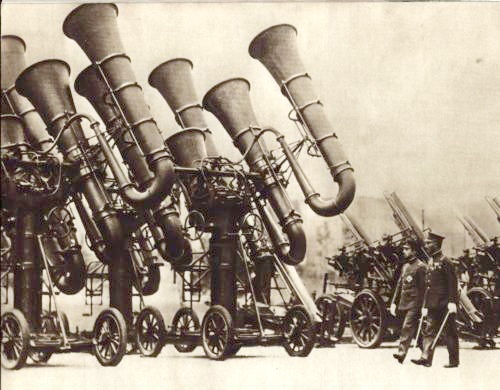
Japanese War Tubas – Actually a type of Acoustic Locator for detecting aircraft before the invention of Radar. (I don’t have a dent ball that big)


Repair Tip –  What I Would Put In A Band Director Repair Kit

In my opinion, most band director repair kits have a lot of what you don’t need, and not much of what you do need. Here’s what I would put in a BD Repair Kit:

  1. assorted screwdrivers – slotted & Phillips
  2. mouthpiece puller – fairy costly, but indispensible IMHO
  3. plain ordinary glue sticks – can be melted with lighter or torch, to put back pads that have fallen out
  4. white Teflon tape – for tenons, neck corks, flute head corks
  5. good quality black electrical tape – for broken/unsoldered braces, covering tone holes, leaking water keys, etc.
  6. spring hook – for putting springs back in position (I can get this for you)
  7. rubber bands
  8. small cable ties – for attaching key guards that are missing screws(better than paper clips)
  9. pipe cleaners – can be used for attaching key guards, as well as cleaning our hinge tubing before re-oiling
  10. key oil – with needle applicator
  11. lighter – although flame dances around a lot
  12. pencil torch – be EXTREMELY careful if you go this route. VERY HOT  – will melt plastic in a hurry, singe corks, surrounding pads, etc.
  13. reed & brass mouthpiece brushes
  14. valve cleaning rod – looks like a flute cleaning rod, just shorter with a loop at the end
  15. flute cleaning rod
  16. rags, etc. (I also cut paper towels into 6 pieces, which give me a 4"x6" mini towel)
  17. pliers – whatever you use make sure they have smooth jaws
  18. clear finger nail polish – for screws that keep backing out


Repair Tool of the Week – Jett Sett

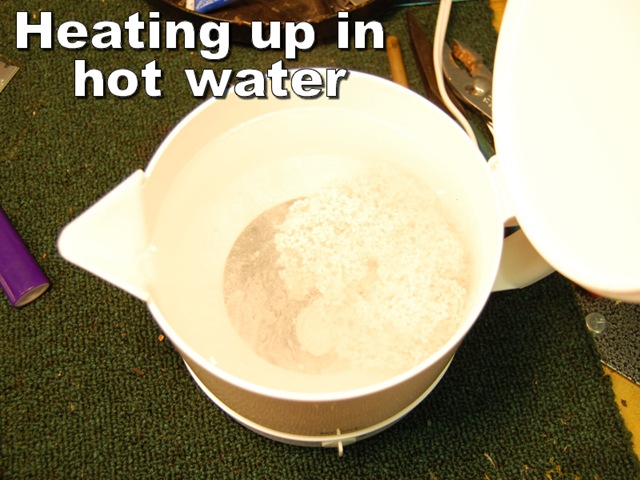
Jett Sett is a heat-malleable ceramic plastic. So, what does that mean? Basically I can heat up Jett Sett in hot water, form it into whatever shape I wish, then after use, it can be re-heated and used again and again. At room temperature, Jett Sett is hard as a rock, but heated up in hot water, Jett Sett has the consistency of modeling clay.

In the pictures below, I’m using Jett Sett to make a mold of the inside of a stuck tuning slide. After the Jett Sett hardens, I can then use a hammer to safely hammer the slide out. The mold provides equal support around the radius of the slide, preventing any damage to the slide itself.  (Just a note, there’s a few things I’ve done to the slide to help loosen the corrosion prior to hammering out)

Jett Sett Pellets Jett Sett Heating

Jett Sett formed Jett Sett mold

This is very cool stuff!

Bench Notes – May 4, 2009

bench notes_bd

  • DINKLES Shoes HOLD Prices for 2009
  • Dead Stock Blowout – Yamaha Bari Sax Mouthpiece
  • Flute/Clarinet Repair Clinic Recap
  • Contrabass French Horn Video
  • Repair Tip –  Clarinet/Sax  Mouthpiece Nicks
  • Repair Tool of the Week  – Leak Lights


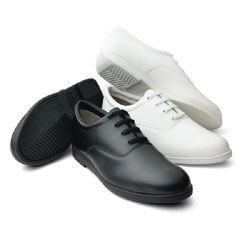
dinkles DINKLES Shoes HOLD Prices for 2009

For those of you using the Vanguard, the Glide, or the Formal, Dinkles is holding price levels for 2009 at the same level as 2008, so Salisbury Music will hold prices on these shoes as well.

Dinkle Vanguard Marching Shoe DINKLES are currently being used by :

  • The Holy Name Cadets
  • The Blue Coats
  • The Crossman
  • Spirit of JSU
  • University of Maryland
  • Westchester University
  • Plus Many More


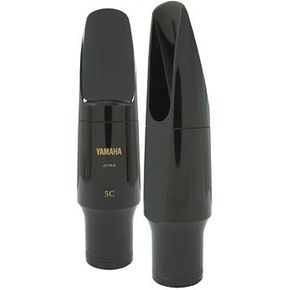
Dead Stock Blowout – Yamaha Bari Sax Mouthpiece

image

Retail Price = $59.95

Normal BD Price = $47.95

BLOWOUT PRICE = $39.99

Only One Available & MP Only


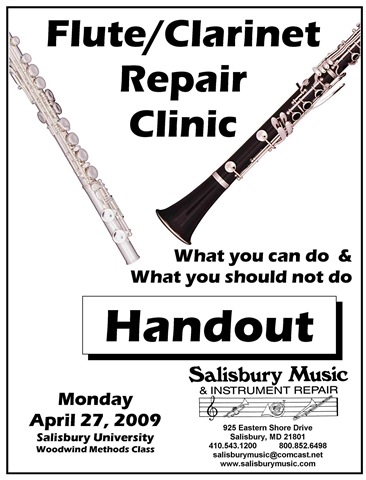
woodwind repair SU 042009 Flute/Clarinet Repair Clinic Recap

As I told you last week, I was invited to speak to the Instrument Methods Class at Salisbury University last week.  I talked with the students about many aspects of repairing flutes and clarinets. At point’s I covered other instruments, but kept the talk mostly to the upper woodwinds. Below is the hand out I gave out. Feel free to download. It is a PDF file.

Download Clinic Handout

Contrabass French Horn Video

YIKES! 5 Valves no less!


Repair Tip – Clarinet/Sax Mouthpiece Nicks

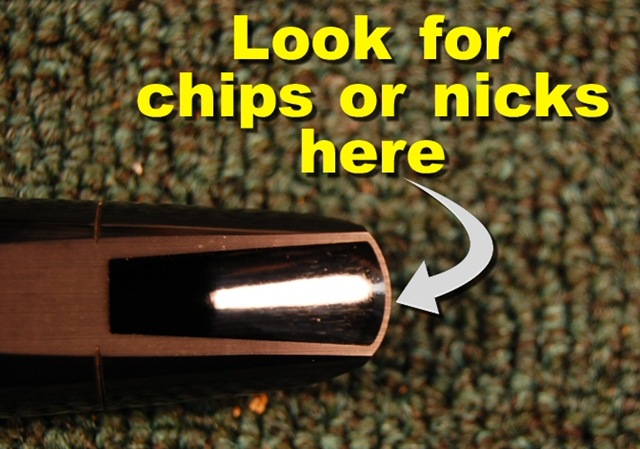
mouthpiece chips

Ever have a clarinet or sax play GREAT one day, then almost totally not play the next day?  One of the things I always check on clarinets and saxes is the condition of the tip of the mouthpiece. It is amazing how a small nick or chip in the tip of the mouthpiece can dramatically change the playing characteristics of an instrument. Mouthpieces get dropped, and often the result is a chipped or nicked mouthpiece tip. Chips or nicks in the rail(s), the flat sides running down to where the reed clamps on, can also have an effect, but not nearly as much as a nick in the tip. Solution? Unfortunately, replacement of the MP.


Repair Tool of the Week

– Leak Lights

Leak Lights

My collection of Leak Lights

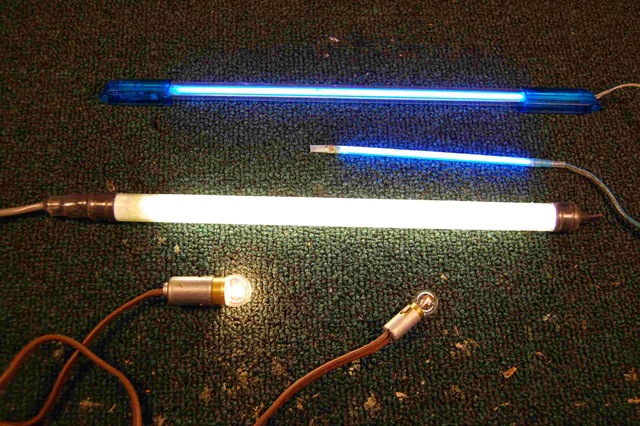
Leak lights are used in woodwind repair to detect pad coverage problems. The light is inserted into the instrument, so that we can see where the pad is not properly covering the tone hole. Where light is leaking out, air will also leak out

Leak Lights

  • Top 2 – Blue Neon bulbs used for flutes and piccolos. The light intensity is dramatically less than fluorescent bulbs, which can bleed through white flute pads. These neon bulbs are actually under-dash car neon bulbs used in high-end car audio customizing shops.  The repair guys at Music & Arts clued me into these.
  • Middle – 12 Inch Fluorescent saxophone leak light. This is the staple of the industry.  They also come in 6” & 20” versions.
  • Bottom 2 – Old School incandescent bulbs. I still use these for bari saxes (bari’s have no access at the top to insert a long bulb)

Bench Notes – April 27, 2009

bench notes_bd

  • New Sign @ Salisbury Music
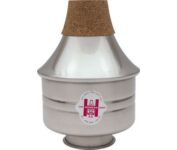
  • Dead Stock Blowout – Harmon Trumpet Mute
  • Flute/Clarinet Repair Clinic @ Salisbury University
  • Cliff Ferree Passes Away
  • Adaptive Technology & Playing a Euphonium
  • Repair Tip – Can you use TOO much cork grease?
  • Repair Tool of the Week


New Sign @ Salisbury Music

DSC_5147 Salisbury Music has a new sign out front. Our old sign was definitely showing it’s age, and ready for replacement or demolition.  Our new landlord wanted a sign out front so they added us to the bottom of theirs. While it is smaller than our previous sign, it is now lit at night, so you lose some, you win some.

Below is a picture of what the whole store front looks like now, with our entrance on the right side.

storefront


Dead Stock Blowout 
– Harmon Trumpet Mute

image

Retail Price = $49.95

Normal BD Price = $39.96

BLOWOUT PRICE = $29.99

Only One Available


Flute/Clarinet Repair Clinic
@ Salisbury University

Fulton Hall - Salisbury University By the time most of you are reading this, I (Joel) will be conducting a flute/clarinet repair clinic for the Instrumental Methods Class @ Salisbury University.  I’ll be talking to the potential new band directors about:

  • What to Look for First in Diagnosing a Possible Repair
  • What You Can Do in an Emergency
  • What You Should NOT Do
  • Good Repairman Communication
  • Student/Instrument Issues that Lead to Repair Problems
  • Issues with “Inexpensive” Instruments

I’ll try and take some pictures and post here next week.


Gary Ferree Passes Away

image This means a lot more to you than you realize. Gary was the son of the founder of Ferree’s Tools Inc..  Ferree’s Tools was one of the first companies in the USA designing and making tools and supplies for the Band instrument Repair Trade. Gary was a major designer and maker of many of the tools every BIR Shop uses everyday. Gary passed away after a long illness.


Adaptive Technology &
Playing a Euphonium

image This is a (video) story of using adaptive technology and allowing a special needs student to play Euphonium using a joystick.

Go Here


Repair Tip      

imageCan you use

TOO much

cork grease? 

Short Answer – YES

Long Answer – Still Yes, but let me explain.  It is very possible to use too much cork grease in the lubrication of woodwind tenons and sax neck corks. Several problems arise from too much usage:

  1. Using too much cork grease causes  the excess to build up in the corners of the tenons. I’ve seen the build-up of excess cork grease so extensive that the tenon won’t seat fully.
  2. The more serious and longer term issue with excessive use is that the cork grease will saturate the cork and eventually break down the glue bond between the cork and the tenon slot. Often time the cork will still be intact, but “be loose” on the tenon. This is a text book example of excessive cork grease usage. 
  3. A secondary problem to excessive use of cork grease is the “remnants” left on the fingers of the player that don’t get wiped off properly. These “remnants” begin to cover the instrument, and especially begin to accumulate in the open tone holes. I can always tell which finger (or fingers) the player uses to put their grease on, because those will be the tone holes with the most built-up grease. (I’ve seen tone holes almost 50% closed with built-up cork grease)

So, how often should you grease your corks? That depends on usage, age of the corks, and tightness of the corks. Basically I would rec0mmend when they need it, i.e., when they start feeling dry, or harder to put on.


Repair Tool of the Week

Sax Body Straightening Tool

sax_body_straightening_mandrel sax_body_straightening_mandrel2

Sax bodies actually will bend quite easily, especially if dropped.  As shown on the picture to the right , the tool is inserted into the neck socket of the sax, and (carefully) aligned so that the force applied will move the body in the direction necessary. Then the opposite end of the tool is “tapped” against the bench to properly align the body. The cool part is the keywork/rods typically go back into alignment as well. Sometimes we have to re-align some keys, but nothing significant typically. The 3 short pieces fit various size alto, tenor & bari’s, so we get a tight fit in the neck socket.  The length of the metal bar part allows for clearance of the keywork over the bench while tapping. I don’t use it a lot, but when I need to…it works beautifully. (Sometimes the “tap” is actually a pretty significant “whack”, especially on larger saxes or more serious bends)

Bench Notes – April 20, 2009

bench notes_bd

  • www.salisburymusic.com
  • Welcome to Bench Notes
  • Dead Stock Blow-Out
  • Essential Elements 2000 Price Increase
  • Band Shoes & Gloves
  • Repair Tool of the Week


www.salisburymusic.com

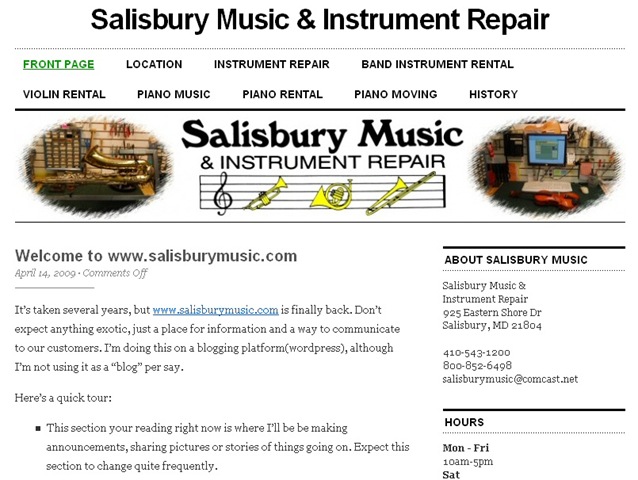
website It’s taken several years, but www.salisburymusic.com is finally back. Don’t expect anything exotic, just a place for information and a way to communicate to our customers. We’re doing this on a blogging platform(wordpress), although we’re not using it as a “blog” per say.

Here’s a quick tour:

  • This section your reading right now is where I’ll be be making announcements, sharing pictures or stories of things going on. Expect this section to change quite frequently.
  • Across the top, above our logo you’ll see a series of “text buttons”. Clicking on one of those will take you to a page with specific information about that aspect of our business. These text buttons will always be visible, no matter what page you happen to be on. Just click on FRONT PAGE, to return to the home page.
  • Down the right side(also always visible) are a series of boxes with information, links, etc.

Thank you for your continued support over the years.


Welcome to Bench Notes

bench notes_bd What you are reading is what will become a weekly newsletter that will be posted on Mondays on www.salisburymusic.com. It will be very similar to the weekly email we have been sending out for the past several months with Repair Tips, Sale Items, Video’s or Article’s of Interest, and who knows what else.


Dead Stock Blow-Out

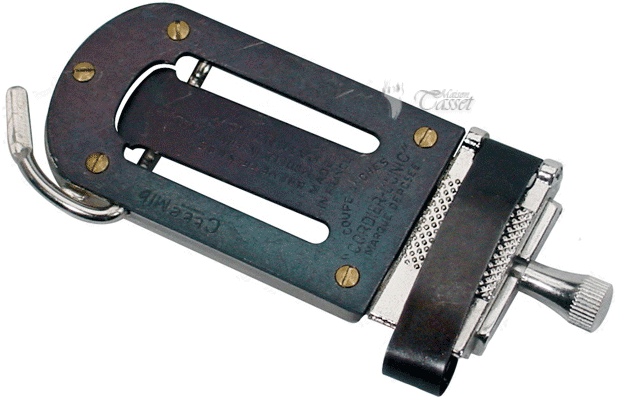
cordier 

Cordier Alto Sax Reed Trimmer

  • Current Retail Price – $50 +/-
  • SALE PRICE – $25
  • Only one available


Essential Elements 2000
Price Increase

The Retail Price of ALL Essential Elements 2000 Books has gone up

ee2k_altobk1Book 1  Was $7.95  NOW $8.99
   (F. Horn & Oboe – NOW $9.99)
   (Percussion – NOW $14.99)

Book 2  Was $6.95  NOW $7.99
(Percussion – NOW $14.99)

Book 3 (Technique) Was $6.95  NOW $7.99

Salisbury Music is holding current prices on existing stock, so if you want Essential Elements 2000 Books at last years prices…..now is the time.

Band Shoes & Gloves

Did you know Salisbury Music sells band shoes & gloves?

drillmaster speedsters

image image

  • We come to your school and size your students
  • We label the boxes with your students names
  • We replace any shoes sized incorrectly

Have any questions? Need a catalog? Want a Price Quote? Give us a call


Repair Tool of the Week

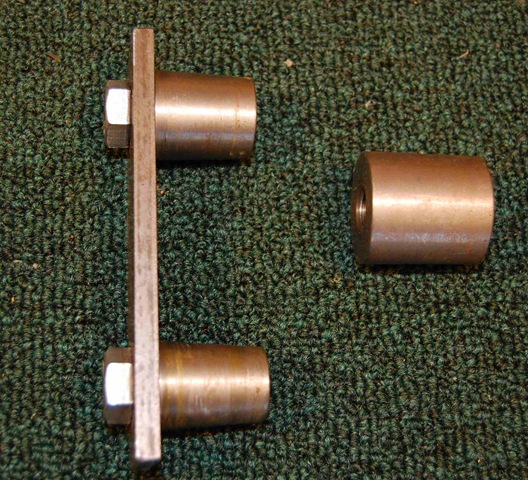
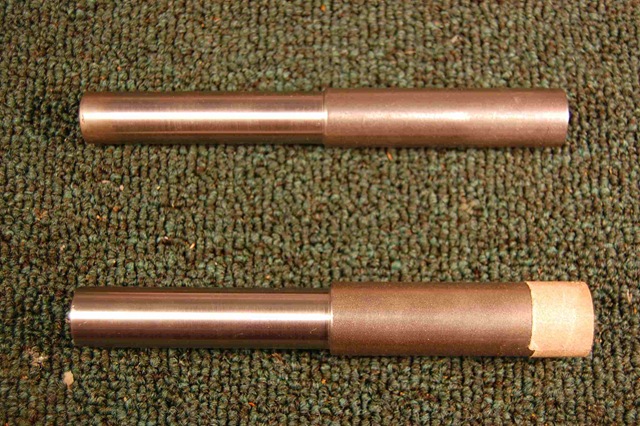
Trombone Cork Barrel Mandrels (tenor trb. on top, bass trb. on bottom)

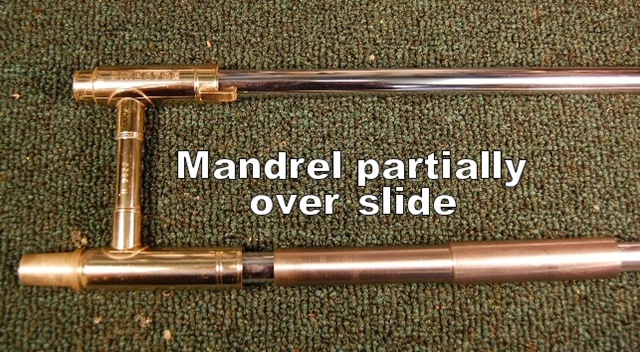
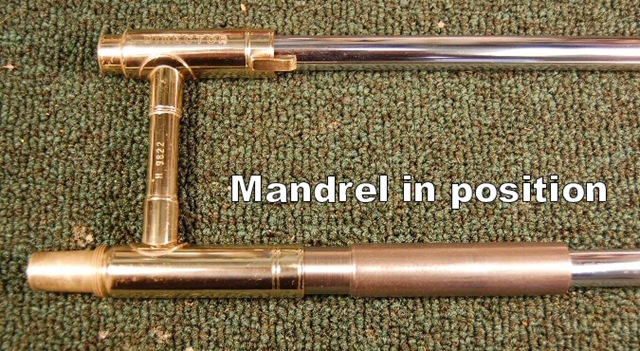
Corkbarrel Dent Mandrel These mandrels are used to remove dents in the cork barrel of the trombone slide. The cork barrels are the 2 pieces of short tubing at the top of the inside hand slide. (the slide lock is on the mouthpiece cork barrel) In the closed position, the outside slide goes up inside these cork barrels.  The smaller end of the mandrel fits between the inside slide and the cork barrel. In the pictures below you can see the mandrel partially over the slide, and fully in position.

cb_mandrel1_text cb_mandrel2_text

The advantage of these mandrels is that we do not have to un-solder the inside slide to remove dents in the cork barrel. We are able to remove the dents much easier, much quicker, and consequently less expensively.

Welcome to www.salisburymusic.com

It’s taken several years, but www.salisburymusic.com is finally back. Don’t expect anything exotic, just a place for information and a way to communicate to our customers. I’m doing this on a blogging platform(wordpress), although I’m not using it as a “blog” per say.

Here’s a quick tour:

  • This section your reading right now is where I’ll be be making announcements, sharing pictures or stories of things going on. Expect this section to change quite frequently.
  • Across the top, above our logo you’ll see a series of “text buttons”. Clicking on one of those will take you to a page with specific information about that aspect of our business. These text buttons will always be visible, no matter what page you happen to be on. Just click on FRONT PAGE, to return to the home page.
  • Down the right side(also always visible) are a series of boxes with information, links, etc.

Thank you for your continued support over the years.

Sincerely,

Joel